
My Venezuelan friends insist that quesillo is unique and nothing at all like flan. They especially point out that quesillo should have tiny holes in it (the way certain cheeses do), and that is probably where the name, which means something like "little cheese," comes from.
Personally, I can't find any difference between quesillo and flan beyond the normal variation in recipes, which can be considerable. For example, I have three recipes for quesillo. One calls for three eggs, another calls for six, and still another requires eight--all for the same amount of milk. Flan recipes are equally variable. So are we making flan or quesillo? Well, I have visited Venezuela and no other Latin-American country, and I love it. So out of devotion to my friends there, I will call this quesillo. I hope you enjoy it, no matter what you call it. And my recipe calls for four eggs. Go figure. (For a printer-friendly version of the recipe, with somewhat less detail than is given below, click
here.)

To make quesillo, preheat the oven to 350* F. Stir together
1 cup granulated cane sugar with
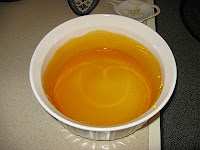
1/4 cup water. Place in a small saucepan over high heat. Once it is combined, DO NOT STIR IT, or it will crystallize. (I learned this, as you might guess, from bitter experience. I stirred my first batch of caramel constantly and ended up with a geological formation in the pan.)
Boil the syrup, watching it carefully. It will caramelize and turn a lovely golden color. This will take a couple of minutes (remember: DON'T STIR! you can swirl the pan gently once in a while).
Once the sugar begins to brown, things happen quickly, so pay attention to keep it from burning. When it's just short of done, remove it from the heat.
Immediately pour the caramel syrup into a 1-1/2 quart mold.
Swirl it around to coat the bottom and sides of the mold. (Imagine holding the mold with one hand and the camera with the other.... The things I'll do for you!)
Here's the finished mold, ready to go.
Now, make the batter. In a blender, whip
4 whole eggs until they are frothy and light. (If you don't have a blender, you can do this with a whisk.) Blend in
1 tablespoon vanilla and
1 tablespoon rum. Some people would say the rum is optional, and you can certainly omit it if you object to alcohol. But it sure makes it taste good--and not at all boozy. Whip everything in the blender again so that it's thoroughly frothy. Pour in
1 14-oz. can sweetened condensed milk, then fill the empty can with
whole milk and pour that in, too. Give everything another go in the blender.
Pour the batter into the prepared mold. Set the mold in a larger vessel, and pour hot water (from the tea kettle is good) into the larger vessel until the water comes between 1/3 and 1/2 of the way up the side of the quesillo mold.
Cover everything with foil, and place it in the center of the preheated oven.
Baking time will depend on the dimensions of your mold. Mine takes about 90 minutes. I take the foil off for the last 10 minutes or so. The quesillo is done when a knife inserted at the center comes out clean, but don't overcook it. It should be firm but creamy, not rubbery.
Remove the quesillo mold from the hot water and set it on a rack to cool.
When the quesillo is cool, run a thin knife carefully around the edge of the mold. Be sure to angle the sharp edge of the blade slightly toward the side of the mold; you are less likely to cut into the side of the quesillo that way. Now comes a fun moment: once you've loosened the quesillo from the sides of the dish, it should move when you rotate the mold back and forth a little. Put the quesillo, mold and all, into the refrigerator for several hours to chill thoroughly.
Once it is good and cold, check to be sure that the quesillo is completely free in the dish, so that it will unmold--it should still move when you rotate the dish. If it doesn't, put some very hot tap water into the larger vessel you used for baking and set the quesillo mold in it for about 10 minutes. When you're ready to plate the quesillo, put a serving dish business side down over the mold.

Pick a dish that has sides, or a least a lip, so that you can catch all the good syrup that has formed. I like a shallow pie plate for this--if the sides are too high, it'll be hard to take the slices of quesillo out when you're serving. (The one in the photo is gorgeous, but a little too tall.) Invert the mold and serving dish in one flamboyant movement. The quesillo should drop onto the dish with a satisfying plop. Lift away the mold, and you're good to go. (By the way, you'll have a layer of caramel resembling hard candy left behind in the mold. That's OK, but it takes patience to get it out of there. Just fill the mold with very hot tap water and let it stand. Use a couple of changes of water over several hours until all the caramel is dissolved.)
Cut wedges of the quesillo (you'll get about eight from this recipe) and drizzle each piece with a bit of the syrup. I like to spritz a little whipped cream onto it, but they don't serve it that way in Venezuela. So do what you like.
 |
| Finished quesillo, after we sampled it. Note the holes. |
The original recipe here came from my good friend Michele Lee, an American who lives in the lovely Venezuelan town of Merida. I made a few small changes (added an egg and reduced the amount of caramel), but it's basically hers. I made this for the first time several weeks ago, when another good friend, Noa Botello, was visiting from Venezuela.
One of the joys of this world is that there are wonderful things in all sorts of places. Take them where you find them, and use them if they work. Be willing to learn from others, and give credit where it's due. Then you can use good ideas (and good recipes) from all over. That's not stealing, it's appreciation.
 My Venezuelan friends insist that quesillo is unique and nothing at all like flan. They especially point out that quesillo should have tiny holes in it (the way certain cheeses do), and that is probably where the name, which means something like "little cheese," comes from.
 To make quesillo, preheat the oven to 350* F. Stir together 1 cup granulated cane sugar with 1/4 cup water. Place in a small saucepan over high heat. Once it is combined, DO NOT STIR IT, or it will crystallize. (I learned this, as you might guess, from bitter experience. I stirred my first batch of caramel constantly and ended up with a geological formation in the pan.)


 Here's the finished mold, ready to go.


